A few weeks ago, the best golfers in the world walked the fairways at Aronimink Golf Club in Newtown Square, a few minutes up the road from Drexel Hill. The PGA Championship does not come to Delaware County often. The last time the major visited Aronimink in 1962, the grandparents of today’s young fans were the same age as their grandchildren. For one week in May, a corner of the county was the center of the golf world.
For Michael Hoover, a certified public accountant who lives in Drexel Hill, the tournament was striking less for the fact that it was hosted in the Philadelphia region, but more so for what it signaled. It was only the beginning. This is the summer Philadelphia is hosting a multitude of sporting events on the world stage.
People who did not grow up in the region sometimes misread Philadelphia fans. They see the intensity and borderline insanity. However, Philly fans would call it passion. Rooting for these teams is something handed down, usually before a person is old enough to choose it, and carried the rest of a lifetime. It runs along family lines and across neighborhoods. It is the reason the area becomes alive for Red October or a conversation with a stranger at Wawa ends in, “Go Birds”. The loyalty is the point. Fans stay through the losing years because the rebuilding years are part of the deal, and because they make the good ones mean something.
That perspective shapes how Hoover, a father, thinks about the summer ahead. Some of his clearest memories are of learning the rituals and rhythms of a season from his own family, learning that you do not abandon a team because they are in a slump or not performing up to the offseason hype. Those lessons turned out to be about more than sports. Patience, loyalty, showing up, taking the long view: a fan absorbs all of it without realizing a lesson is being taught. Now he is on the other side of it, passing the same thing down to his newborn son. He looks forward to taking him to his first Phillies game this summer.
That is the lens Hoover brings to what is about to unfold across the region over the next several weeks.
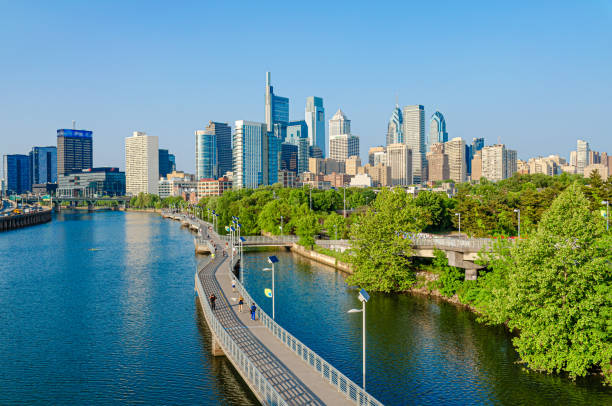
Starting in mid June, Lincoln Financial Field, temporarily renamed Philadelphia Stadium, hosts six matches of the FIFA World Cup. Brazil, France, Croatia, and others will play a short drive from Hoover’s office and their home. The tournament spans sixteen cities across three countries, and Philadelphia drew one of the prizes of the entire schedule, a Round of 16 match on the 4th of July. The most-watched sporting event on earth, in its knockout stage, in this city, on the 250th anniversary of the country founded a few miles from the stadium.
Ten days later, the All-Star Game comes to Citizens Bank Park on July 14th, the first Midsummer Classic played in Philadelphia in thirty years. There is a detail in that history Hoover keeps returning to. The last time the nation marked a milestone birthday, the Bicentennial in 1976, Philadelphia hosted the All-Star Game then too, at Veterans Stadium. Two hundred years, and the country turned to the same city. Now it is happening again at two hundred and fifty. Some places host these moments. Philadelphia, Hoover notes, seems to be where the country comes to remember who it is.
For people outside the region, it reads as a busy sports calendar. For those who live here, it is something closer to a family reunion held on the world stage. The golf major already brought a few hundred thousand visitors into Delaware County. The soccer matches are expected to draw hundreds of thousands more. The hotels, the restaurants, the small businesses, the neighborhoods near the stadiums all feel the lift. As someone who spends his working life looking at the numbers behind small businesses and families, Hoover says a summer like this does not come around often, and the benefit reaches well beyond the people holding tickets.
The part he keeps coming back to is not economic. It is seeing this all unfold through the eyes of a child.
There is a generation of kids in Drexel Hill, across Delaware County, and throughout the region who will spend this summer watching the world arrive in their backyard. Some will see their first World Cup match. Some will be in the stands when the All-Star Game returns after thirty years. Most will simply absorb the feeling of it, the sense that the place they are from matters, that it is worth being proud of, that the rest of the world wanted to be here. That feeling becomes part of who they are. It is the same handoff Hoover’s own family gave him, on a scale none of them has seen before.
Years from now, teenagers will tell their own children about the year the World Cup came to the Linc, the year the All-Star Game came back, the year the country turned 250 and chose Philadelphia to celebrate it. They will not remember every score. They will remember that they were here, and that it belonged to them.
That, to Hoover, is what fandom is underneath the noise and the arguments and the painted faces. It is a way of belonging to a place. This summer, the city gets to share that feeling with the entire world.
He would not want to be a fan of anywhere else, he says. Not this year. Not ever.
Lorem ipsum dolor sit amet, consectetur adipiscing elit. Ut elit tellus, luctus nec ullamcorper mattis, pulvinar dapibus leo.
Lorem ipsum dolor sit amet, consectetur adipiscing elit. Ut elit tellus, luctus nec ullamcorper mattis, pulvinar dapibus leo.