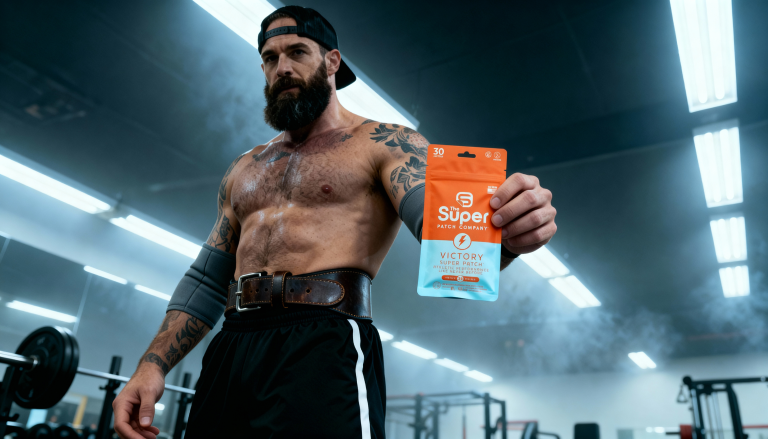
Jay Dhaliwal, the CEO and founder of Super Patch, made a vow to his mother that he would find a way to help her regain her sense of control over her body after she was diagnosed with Multiple Sclerosis. The disease disrupts signals between the brain and the body, with MS-damaged nerves acting like frayed wires with static.
Super Patch was born out of Dhaliwal’s personal mission to improve his mother’s quality of life. Dhaliwal spent 15 years of his life pursuing an answer to an important question: Can we restore broken brain signals through the skin without drugs or surgery?
“We aren’t just another patch company; we are a neuro-tech company that has found a way to use touch to trigger the brain’s own healing and performance pathways,” a spokesperson for Super Patch says.
Dhaliwal traveled the world to consult with experts, and his research led to the creation of the Super Patch. The patches may look like simple stickers, but they have micro-encoded patterns that interact with the body, called Vibrotactile Trigger Technology (VTT).
“We view the skin as the body’s most powerful, untapped sensory interface. We are the only brand treating wellness as a communication problem between the brain and the peripheral nervous system,” a spokesperson for Super Patch explains.
Super Patch is a neurosensory innovation that aligns with the company’s philosophy of helping the body function naturally. When placed on the skin, the pattern creates a subtle physical signal. It doesn’t use electricity, heat, or any chemicals. The patch isn’t fixing the underlying physical issue, but it is creating a clear signal to the brain, which then guides the body’s functions. The patch’s purpose is to push a signal through the “static” caused by various health issues, such as MS.
Dhaliwal’s determination to find a way to help his mother reached a “full circle” moment when she used the Super Patch he’d developed. After struggling with MS since the 1980s, she was able to move better and once again felt like herself.
After seeing the success of his patch on a personal level, Dhaliwal opted out of the “hype-cycle” in Silicon Valley. He wanted to lean into hard science and clinical proof to counter the skeptical critics he had encountered throughout the patch’s development. According to Dhaliwal, Super Patch has undergone 16 peer-reviewed, published clinical trials. Six of the studies have been indexed in PubMed. The University of Arizona has also conducted research on the Super Patch.
“The data is definitive, with p-values (0.001) that exceed many pharmaceutical standards for efficacy,” a spokesperson for Super Patch shares.
P-values are how scientists measure how likely a result is to have happened by chance. A low p-value (0.001) shows strong evidence that something real is happening.
Super Patch has surpassed a $200 million annual revenue run rate in 2025. This is without venture capital or outside capital. Dhaliwal calls his company “people-powered” because of the power of word-of-mouth among Smart Patch users.
The Super Patch has gained the trust of 12 NFL teams. Athletes from other major leagues, such as the NBA, NHL, and MLB, are interested in the patch’s benefits. Dhaliwal also claims that thousands of MDs have recommended the patches to their patients.
The success of the Super Patch indicates people’s interest in non-surgical, non-chemical solutions. They are looking for a “Third Option.”
“We are providing a drug-free, non-invasive, and affordable path to wellness that honors the body’s innate intelligence,” a spokesperson for Super Patch concludes.
Lorem ipsum dolor sit amet, consectetur adipiscing elit. Ut elit tellus, luctus nec ullamcorper mattis, pulvinar dapibus leo.
Lorem ipsum dolor sit amet, consectetur adipiscing elit. Ut elit tellus, luctus nec ullamcorper mattis, pulvinar dapibus leo.