The Harvard team’s infrared eye-tracking headset aims to bring concussion screening closer to schools, youth leagues and the people responsible for athlete safety.
A new piece of sports technology has to do more than work in a demonstration. It has to fit into the routines of the people who might actually use it, whether that’s an athletic trainer at a school, a coach overseeing a youth league or a medical professional evaluating an injured athlete.
That’s the challenge facing Rumble Rims, a concussion-screening headset developed by three Harvard University students. The invention has won the Global Medical category of the 2026 James Dyson Award, earning creators Cleo Pontone, Radhika Saran and Sophia DeVito $40,000 to continue development.
Their ambition is to make objective screening more accessible in the places where athletes actually compete, rather than limiting the technology to specialized medical environments.
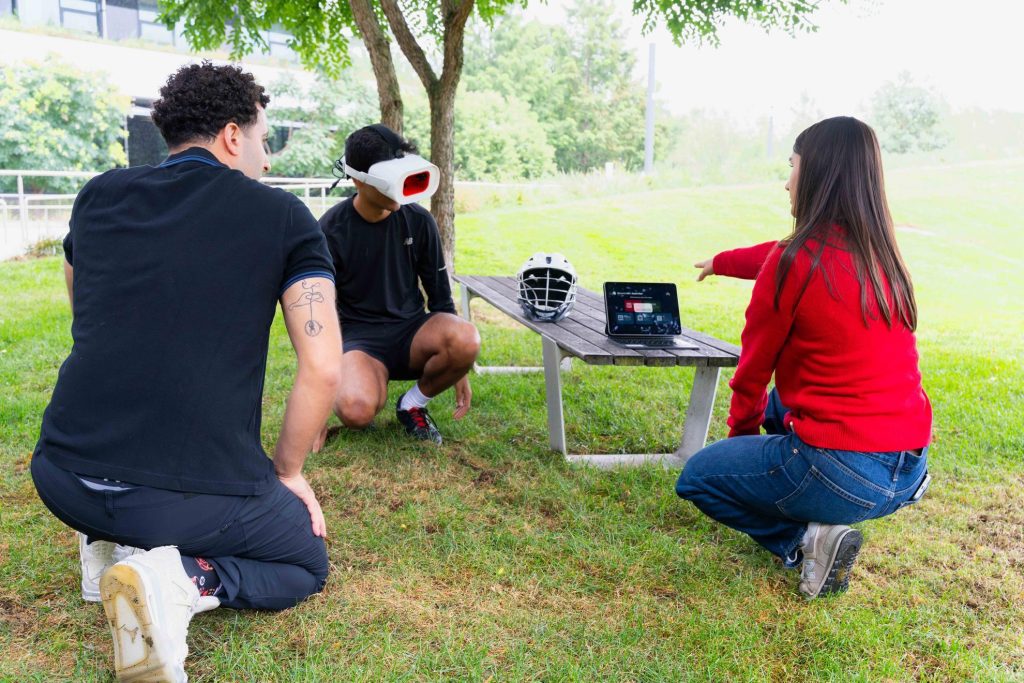
Rumble Rims is designed to measure eye movements that can provide an objective indication of possible neurological impairment. Using infrared cameras, the headset tracks how an athlete’s eyes follow, fixate and move during a two- to three-minute assessment.
The measurements are displayed through a mobile interface, providing additional information that can help inform whether an athlete should be removed from play and referred for professional medical assessment.
For sports programs, the appeal is potentially practical. Access to specialized concussion-screening equipment and medical expertise can vary considerably between organizations. A professional team and a small school athletic department don’t necessarily have the same resources, even though both have to take possible head injuries seriously.
Rumble Rims is being developed with those differences in mind. Its intended use on the sidelines could give coaches and trainers another resource when an athlete needs to be evaluated, although the device is not designed to replace medical professionals or existing concussion protocols.
That distinction matters. The headset is a screening tool, not a diagnostic device, and it cannot independently determine whether an athlete is ready to return to competition.
One of the more interesting aspects of Rumble Rims is that the team isn’t limiting its ambitions to the initial sideline assessment.
The system includes a recovery dashboard that supports repeat testing over time. This creates an ongoing record that athletes, families and clinicians can use to follow progress during recovery.
That could give the technology a role beyond the immediate aftermath of an injury. Rather than treating each assessment as an isolated event, the dashboard is designed to help document changes over time.
The broader question is how that information might eventually fit into the work of medical professionals and sports organizations. A screening result is only one part of the picture, and its usefulness depends on how it is interpreted alongside other clinical information.
Sir James Dyson, who selected Rumble Rims for the Global Medical award, recognized the importance of bringing screening closer to sporting environments.
“Cleo, Radhika and Sophia have found a new way to bring objective screening to the sidelines, where the critical decisions are made,” he said.
The award gives the students funding to address the next stage of development. Their plans include building a higher-fidelity prototype, refining the eye-movement assessment and conducting additional testing with athletes, coaches, trainers and medical advisers.
They also hope to pilot Rumble Rims with schools and youth sports programs and pursue medical device validation.
Those steps will be important. Before a new screening device can become part of a sports organization’s routine, it needs to demonstrate that it works reliably, that the people using it can understand its results and that it fits appropriately within existing medical procedures.
The team has already explored several physical configurations, including helmets, mouthguards and chin rests, before arriving at its current headset design. Feedback from medical professionals and coaches helped inform that development.
Now the emphasis shifts toward testing the technology in the environments it was created to serve.
Rumble Rims was selected from a record 2,294 entries submitted to the 2026 James Dyson Award across 28 countries and regions. The competition has supported more than 400 student inventions since its launch in 2005.
For Pontone, Saran and DeVito, the $40,000 prize represents an opportunity to move beyond the initial concept and work toward practical applications.
The larger ambition is worth watching. Sports organizations have increasingly sophisticated tools for tracking performance, but technology that helps inform decisions about athlete health has its own set of requirements. It must be useful, understandable and supported by appropriate medical oversight.
Rumble Rims still has testing and validation ahead before it can establish a place in those environments. Whether it eventually becomes part of a school’s regular sideline equipment will depend on what the next phase of development reveals.
For now, the James Dyson Award has given the team a meaningful opportunity.
Lorem ipsum dolor sit amet, consectetur adipiscing elit. Ut elit tellus, luctus nec ullamcorper mattis, pulvinar dapibus leo.
Lorem ipsum dolor sit amet, consectetur adipiscing elit. Ut elit tellus, luctus nec ullamcorper mattis, pulvinar dapibus leo.